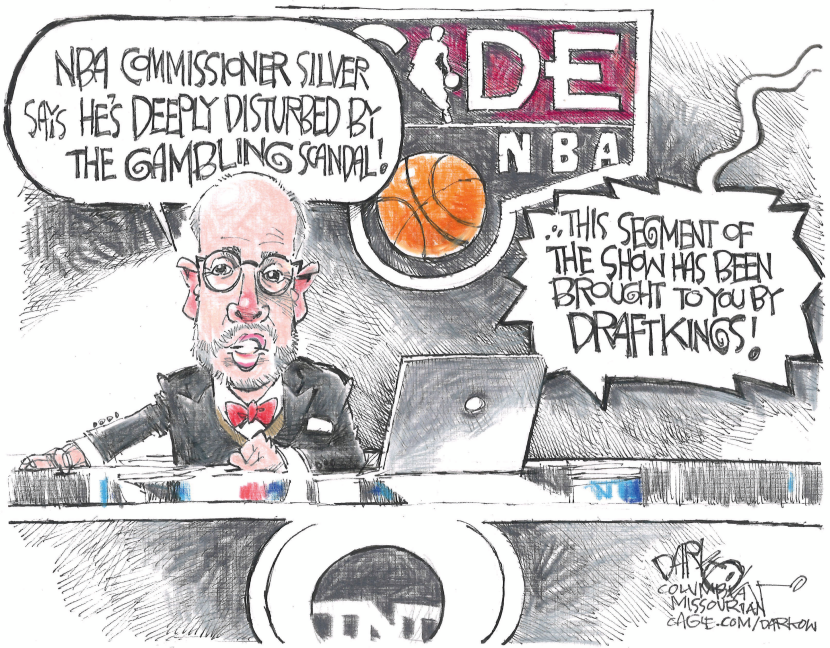
In September of 2022, I wrote an article entitled “Unrestricted Gambling is a Bad Bet.” My friend Ed MacDonald provided a comment in which he said “Who wants to give me odds that there will be a major gambling corruption scandal in organized sports within the next five years?” Well Ed, you were way off base. It didn’t take anything like five years.
In July of this year two of the best baseball pitchers, Emmanuel Clase’ and Luis Soto of the Cleveland Guardians, were suspended by Major League Baseball (MLB) pending the outcome of an investigation into alleged gambling activities. In early November, the other shoe dropped on this story. Both pitchers were indicted on allegations that they had “pitched to order”, throwing pitches that were balls or strikes, or above or below certain velocity, in order to allow gambling partners to win on in-game proposition bets.
Several other baseball players have been suspended by MLB for betting on baseball games. One, Tucupita Marcano, has been banned for life for betting on games in which he had “the duty to perform”, and thus might affect the outcome. Four others were suspended for a year for betting on minor league games. These guys weren’t indicted because there was no evidence that they’d done anything to adversely affected the outcome of the games on which they’d bet.
Shohei Ohtani, arguably baseball’s brightest star, paid $4.5 million in gambling debts, but was able to avoid lifetime ban from baseball when it was revealed that the bets were placed by his interpreter. Poor Shohei knew nothing about it, and was the victim of his gambling-addicted assistant. I buy that. Cough, cough.
A couple weeks before the baseball investigations resulted in indictments, the NBA received their own black eye. Charges have been brought against hall of famer Chauncey Billups, Damon Jones and Terry Rozier along with some three dozen others with organized crime backgrounds. The NBA has initiated its own investigation, and have requested access to cell phones from individuals on a number of teams including the LA Lakers (“hello is this LeBron?”)
Interestingly, these various allegations don’t really include “throwing the game”. In-game proposition bets (prop bets) on what pitch a pitcher might throw in a given situation, or what a basketball player’s personal stats might look like in a given game were where the gravy lay. Additionally, insider information was provided to the gambling professionals.
The NBA stars were also used as Judas goats to entice suckers into rigged games. One story states that “The feds say that Billups was a “face card” in the scheme, helping to lure players in April 2019 to games held in Las Vegas, where a rigged shuffling machine was used to dupe victims of at least $50,000…. Jones is also accused of using his notoriety to get people to poker games rigged by organized crime figures in order to steal money from them, sometimes using technology, including poker chip trays with hidden cameras, and rigged shuffling machines with the ability to read the cards in the deck.”
A year earlier, a young Canadian player in the Toronto Raptors organization was suspended for life by the NBA for his involvement in gambling. Having run up significant gambling losses, he was given the opportunity to participate in a number of “specials” to work off his debt. “Awawdeh and his co-conspirators would bet that Porter would fall short of certain benchmarks. Porter then feigned injury to leave games early, ensuring the bets would hit.” Sadly, for Porter, the pattern of prop bets stood out like a sore thumb. He was subsequently charged, convicted, and sentenced to six months in prison with a 41 to 51- month supervised release period to follow his incarceration.
Will we see similar stories about the NFL, or the NHL? Well, the NFL is digging into it. Three players were suspended for betting on games involving their own teams. Two of those players have been reinstated. The NHL had a minor gambling scandal in 2006 which resulted in a two-year suspended sentence for Rick Tochet coupled with a two-year suspension by the NHL. More recently, Evander Kane has been investigated by the NHL. “While he has a murky relationship with gambling and claims to have lost $1.5 million to it, no proof relating to betting on NHL matches surfaced.” Shane Pinto was suspended by the NHL for half a season for online proxy gambling, which violated league rules. So, trouble is bubbling just below the surface for those leagues as well.
If you’re a serious sports fan, this picture is disturbing. The integrity of sport (or the perception of integrity in sport) is being challenged, and while serious fans will tolerate poor performance and disappointment, we need to feel that we are watching a bona fide competition. If the true sports fan comes to believe that they’re watching a manufactured result, the tv clicker will vote no. And then major sports will be in serious trouble. Because while gambling is becoming significant revenue stream for sports leagues, TV is still the big kicker, isn’t it?
That is not, however, the major reason for my concern. The real reason for concern is damage that problem gambling is doing and can do to Canadians, and especially younger Canadians.
The Canadian Mental Health Association, in a submission to the Alcohol and Gaming Commission of Ontario, said “Youth and young adults are particularly vulnerable to at-risk gambling following exposure to advertisements. In Ontario, we’re seeing an alarming increase among students in Grades 7 to 12 betting money on online gambling. Gambling-related harms such as financial loss, mental health issues, substance use, and suicide ideation, can have devastating and long- lasting impact on the individual and their family.” In their view gambling is a greater problem for more impulsive young people, and gambling advertising is normalizing gambling as a “cool” activity for the young.
Cardus, a non-partisan think tank published a document on gambling harms in 2024. It makes the following statement. “Compared to those who spend less than 0.1 percent of their income on gambling (that is, someone who gambles occasionally or not at all), someone who exceeds the 1 percent threshold is 4.3 times as likely to experience financial harm, 4.7 times as likely to experience relational harm, 3.9 times as likely to experience emotional or psychological harm, and 4.4 times as likely to experience harm from health problems related to their gambling.” The 1% threshold to which they refer is 1% of household income. Cardus reported that the average annual household income in Ontario in 2022, which was the last year for which data was available at the time of writing, was just north of $106000. The 1% threshold for the average household would be net losses of $89/month, and lower than that for lower income families. Are Ontario households losing more than $89/month? You bet your ass they are.
In the year ending March 31 2025, OLG took in 9.3 billion dollars and paid out $2.6 billion, for a total revenue of $6.7B. That doesn’t represent profit, because there are commissions and provider fees to be paid. But net player losses were $6.7B. And OLG isn’t Ontario’s only finger in the gambling pie. Ontario also has iGaming Ontario, or IGO, which is the entity that licences gambling houses like BetRivers.Net and BetMGM and all the other names familiar to you from their incessant and annoying TV commercial campaigns. IGO gross gaming revenues (wagers minus winnings) in fiscal 2025 were approximately $2.9B, meaning that Ontario households lost about $9.6B in total.
Stats Canada indicates that Ontario held approximately 6 million households in 2023 (somewhat larger now, one assumes, but the best estimate I can come by) which means that average household loss was $1600, or $133 per month. OK, you will say, that doesn’t sound terrible. It’s over that $89 “safe” level, but only by about 50%. But remember, that there are a whole bunch of people who are way below average, which means that there are a number of people who are losing substantially more than $133 per month.
A web-site called madeincanada.ca tells me that only 2-4% of Canadians surveyed report that they spend more than $100/month gambling. Another 12 to 17% report spending $20 to $100 per month on gambling. However….
A report by StatsCan tells us that you cannot believe that survey because survey reports on gambling revenue don’t come close to explaining OLG and IGO revenues. Obviously, people aren’t too keen on revealing their actual gambling habits.
How much do you think people in the top decile are losing? I did an AI query and got a range of estimates that suggests that the top 10% of gamblers are losing between $750 to $1760 per month to their gambling habit. I didn’t chase that any farther, so it remains a crude estimate. I would suggest to you, however, that most people don’t spend anything near the average of $133/month, and therefore I believe that the top decile spending probably trends towards the higher end of that crude estimate range. And statistically that means they are at much higher risk of financial harm, health harms, or relational harms including suicide and domestic violence associated with their gambling
I did find out that consumer insolvency declarations in Ontario increased by 17.8% in 2024, rising to 51,600. Public health researchers show pathological gamblers have much higher lifetime rates of bankruptcy than low-risk gamblers.
Concerned experts are warning us that gambling is still growing in leaps and bounds. Gambling has doubled in just the last two years. Casino gambling wagers jumped from $28B in 2023 to $52B in 2024. iGO accounts jumped from 492,000 in Q1 2023 to 1,300,000 in Q4 2024. But there’s more to this picture than just the number of people having an odd flutter on a sure thing. How people gamble is changing dramatically. It used to be that you picked a winner in the prize fight or a big horse race and you placed a bet and then waited for days or weeks to see what happened. These “outcome bets” are still out there, but they take a long time to deliver, don’t they? If you sit in a casino, you can keep plugging quarters into the slot machine and you can make hundreds of bets in an hour. How fast and how much you can bet increases the intensity of the experience, as well as increasing the probability that you’re about to lose your shirt.
The problem for gambling addicts now is they don’t need to bother going to a casino. Do you have a tablet or a smartphone? That thing is now your own personal private casino. You can visit it anytime in any weather, and the drinks are cheaper. You can play casino games – slot machine games, poker, blackjack etc., or you can bet your mortgage money on whatever sports contest is on tv. And it’s as fast as you like. You don’t need to wait for the game to end. You can bet on whether Luis Soto will throw a first pitch strike, or whether a basketball player will get six points in the first quarter.
Speaking of Electronic Gaming Machines (EGM’s), one article says “The smartphone becomes a portable casino that lets gamblers play anywhere and anytime, including alone, drunk, or high. Instead of dropping change into a machine, players link a credit card to their online gambling profile(s), making it easy to access more money if they start to lose.”
They then go on to look at sports betting and assert that “the introduction of in-play bets has changed sports betting from a game like the lottery—make your predictions, then sit back and wait to see if you won—to a game more like a slot machine, where you can bet continuously throughout the game. In-play betting has many of the same structural characteristics that make electronic gambling machines so dangerous. These include short intervals between bets, near misses (if some but not all conditions of a multiple-event wager are met), and high multiplier potential (the chance to bundle wagers across multiple events and thus create longer odds and higher possible payouts). It makes sports betting faster and more impulsive and gives players more opportunities to chase losses within the game.”
Keep an eye on the gambling house commercials the next time you’re watching a sports event. Try to keep track of how often you see a gambling ad during that event. But also, try to keep count of how many of those ads extol the virtues of in-game betting. In-game betting is a high profit feature. Not only does it offer the gambler the opportunity to bet faster and less carefully, the gambling house profit margins on such bets are higher – up to 30% in some cases, or five to six times more than straight bets.
As if gambling isn’t already unrestricted enough, the Ontario Court of Appeals recently came down with a verdict declaring that online peer to peer gambling (online poker for example) is wide open to players from any country outside Canada. Do we really need that?
How does Canada, and Ontario in particular, compare to other countries in their protection of at-risk gamblers?
- Australia, an early pioneer into legalization of gambling has banned online in-play betting since 2001.
- Finland is currently in the process of licencing gambling sites, turning away from the current government monopoly, but they appear to be licencing EGM’s and games of chance, not in-play sports betting.
- Gambling in Norway is limited to a government monopoly. Wikipedia tells me that “In June 2010 the Norwegian Government passed a law that forced all banks in Norway to deny the customers the use of credit and debit cards at land and online casinos all over the world.”
- In the UK, the gambling regulations include a limit on lottery bets with an even tighter limit for those under 25 because younger adults are more vulnerable to gambling harms. The recently tightened regulations include “financial vulnerability checks to identify at-risk players and a pilot programme for frictionless financial risk assessments.” The UK does, however, offer online in-play betting.
- Germany adopted gambling regulations on 2021 which “set out strict regulations for gambling operators, including a ban on certain games, deposit limits, an advertising ban as well as mandatory ID-checks.” Germany permits in-play betting.
That little survey tells me that Canada is less restrictive than some countries when it comes to online gambling, and broadly in line with many others. Why do our governments not move to regulate gambling and reduce the social damages that gambling is introducing? The answer is simple. It’s a growth industry, and the government isn’t interested in doing much to rein it in because the government is making a piss-pot full of money. The purveyors of gambling services are also making a fortune, so there’s not much impetus to turn off the tap.
What would I like to see?
- I’d like to see a drastic reduction in gambling advertising.
- I’d like to see a government regulation requiring that for every five ads promoting online gambling, the gambling interests must fund an anti-gambling tv ad produced by an agency like the Canadian Mental Health Association.
- I’d like to hear sports commentary discussing sports strategies, player strengths and weaknesses, player profiles…anything but the endless discussions of what your best betting odds are for this event.
- I’d like to see sports being about the game results and the athletes’ results, not about the gambling results.
- I’d like to see limits on how much gamblers can risk.
- I’d like to see a ban on online in-play prop bets.
- I’d like to see rapid identification and treatment of gambling addiction.
In the meantime, if you are a bettor, take a little time to reflect on whether your betting patterns are safe and reasonable. Be honest with yourself and get help if you need it.
8 responses to “Ontario – Fleecing the Gambling Addicts”
Hi Dennis: I have been a long time proponent of a total ban on sports gambling or at the very least serious controls. Unfortunately that will never happen. It is the gravy train for organized crime involved in gambling.And in recent years the governments profit greatly from gambling which they sanction. There is even gambling in curling. OMG!
I like all your ideas but unfortunately they are all idealistic and don’t have much chance of success.
I am very tired of seeing the dark haired wench on the Fanduel desk who knows nothing. I turn away.
Gambling is all over the t.v. Do you think the networks will agree to ban or limit gambling and throw aaway all that revenue? Not a chance.
On a better thought–see you in a week for food,beer and idle conversation.
Hi George. Thanks for commenting. I don’t think a total ban on sports gambling is realistic or even terribly desirable. I think government attempts to ban alcohol and to ban cannabis have shown that total bans are pretty hard to enforce and create problems of their own. I think government control of gambling helps get it out of the dark underworld of organized crime and that’s not a bad thing. However, I agree with you that the key to government-regulated gambling is “regulated“. I don’t think Doug Ford, alleged high school, drug dealer, andbrother to cocaine-snorting Rob, is terribly concerned about effective regulation. He’s much more interested in the money.
You mention how much the Ontario government makes off betting, somewhere in the range of 9 billion dollars. Beside the cost for running their lottrries where does the profits go? I know some places but a list would be helpful. I play a 50/50 lottery run by the Thunder Bay Regional Hospital. 50% goes to the winner and 50% goes to the hospital to help with the cost of medical care for people of Northern Ontario. This 50/50 lottery has become extremely popular because people can see where the money is going. The Blue Jays did the same thing raising 20 million for Jays Care.
Are people supporting these causes to help these places or to win a lot of money? Probably a chance to win. But I don’t have a problem with these gambling sites. You see where the money is going.
As for these other sites the object of their being is too make money. Vegas was not built to lose money but to make money. That is why the Mafia were the first investors. And these betting sites make it look so easy to win that they are no better than the Mafia. There is an old saying ‘A sucker is born every second’ and these sites exploit that.
Good morning Paul. thanks for your comment. The “who benefits” question is answered in a couple of ways in the OLG annual report. It states “has helped support provincial priorities including the operation of hospitals; problem gambling prevention and treatment; amateur sport; and local and provincial charities, among other initiatives. In addition, there are several direct beneficiaries of Lottery and Gaming proceeds, including host communities, Ontario First Nations, lottery retailers, charities and Ontario’s horse racing industry.”The report also states that OLG is “one of the Ontario government’s largest sources of non-tax revenue.” I think the first statement about hospitals etc is smoke and mirrors. The truth is in the part that says “support provincial priorities” as a “source of non-tax revenue.” This money goes into general revenue and gets spent wherever the government thinks it’s needed.
I don’t think, to be honest, that it matters a lot how the money is used. The people aren’t gambling to support a cause. Most people are gambling for the right to dream just a little, and the addicts are gambling for that adrenaline hit when they win a big one. They don’t care about how the profits are distributed.
Dennis, I couldn’t agree more. I used to marvel at how the Puritans were such spoil sports, banning gambling, drinking, and Xmas and fun in general. But I at least now see their point. I watch the sports news shows every morning and they are underwritten by gambling sites and laced with gambling odds and assessments as an integral part of the actual show. Things have gotten out of hand and everyone is complicit. Periodically, telling viewers not to gamble too much and reminding them that outcomes are less predictable than one might think is like telling an alcoholic not to drink too much. We are living in an epidemic of addiction and so, the Puritan approach is impractical, but some of your suggestions would help limit the damage.
Howdy Ed. Thanks for your comment. I agree with you that the ad bits about gambling responsibly are useless. I regard them as lawyer-ish additions to try to prove due diligence in some future litigation. More government regulation to limit gambling ads would be desirable. I think in a previous article I suggested that instead of including a cautionary note in a buy-here ad, we should have the gambling industry fund a series of ads produced by some agency like the Mental Health Centre which sells the other side of the gambling coin. (Actually, that’s so good I might amend it into the article!)
It certainly seems that we are going to hell in a hand basket with gambling. Greedy governments and greedy people are not going to self-regulate so some kind of stricter laws will be required. But I’m not holding my breath!
I was amazed with the baseball and basketball scandals that were revealed recently. Did that dissuade any gamblers? I doubt it! Even the fact that organized crime is rigging the game using technology probably did not sink in to the heads of problem gamblers. Will the predatory Ford government take action?
But the whole issue leaves me feeling pretty good: since I don’t gamble, I’m up a good bit of money every year! 😉
Hi Terry. Thanks for commenting. I think that problem gamblers are immune to suggestions that they’re playing in a rigged game. That happens to other guys, mugs, but not to them. As for the predatory Ford government, they were victorious in court last week in an appeal to open up the gambling scene even wider – that’s what prompted the ruling that you could do international “peer to peer” gambling – i.e, online poker. So no, they’re not interested in taking action to rein in their profitable gambling scheme.