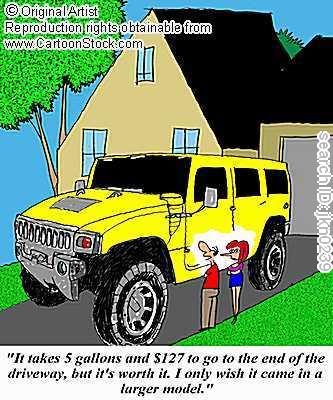
About 30% of vehicle sales in Canada, excluding large commercial vehicles, are pickup trucks, full-size SUV’s like the Ford Expedition, or 3-row “intermediate” SUV’s like the Kia Telluride. At the risk of getting myself banned from pickup-crazy Bruce County, that’s just wrong. Make me dictator for a day and I’ll get about 90% of those vehicles off the road. Why, you ask? What have I got against pickup trucks?
Well the first thing is that they offend my logical sensibilities. Back in the 1960’s, the pickup was a working vehicle. It had a nice long cargo box and a small cab with a single bench seat. It didn’t have any seatbelts, so you could legally cram 4 or 5 small kids in the cab. (I know because my dad did that, and the rest of us would ride in the back). Back then the bed was about 2/3, and the cab was 1/3 of vehicle length.
Pickup trucks in 2026 are nothing like that. 98% of pickups sold in Canada have seating for 5 or 6 passengers, who ride in air-conditioned comfort in a 5000 lb or 6000 lb vehicle which has a truck bed that accounts for only 1/3 of vehicle length. So what is that vehicle? Is it a working vehicle, or a passenger car? Truck devotees will respond, no doubt, that “that’s the great thing about it. It’s both. You can have the best of both worlds.”
Which sounds great. But in fact, they are rarely used as multi-purpose vehicles. Survey data says that there is something in a pickup’s cargo bed about 0.2% of all road trips and that there is someone in the rear seat of a 5 passenger crew cab about 5% of the time or less. Mostly the back seat of a crew cab pickup is used for groceries because they don’t slide around there like they would if they were in the truck bed. Well, I’ve got news for you. The back seat of a car handles groceries just fine. I look at these testosterone laden, parking-challenged behemoths being used for something that could be readily accomplished by something as small as a Mini most of the time and I just shake my head.
But that’s just my personal and somewhat obsessive need to have things designed for purpose and to have them used as designed. Are there other reasons to complain about the overuse of pickups?
Of course there are, or I wouldn’t be writing this. And by the way, I pick on trucks specifically in much of what is written below because it’s easier to find data broken out for trucks as a class. SUV data may be smeared across the whole class from the 2600 lb Hyundai Venue to the 9600 lb Hummer. Many of the issues that are pertinent for pickup trucks are common to the larger SUV’s as well, so while I mostly refer to trucks, you can broaden that statement in most cases to include larger SUV’s.
So, that being said – large vehicle problems. First of all, they totally screw up parking. Parking spots aren’t designed to accommodate trucks. Most municipalities regulate parking spots to be 2.6 meters wide. If you park two trucks side by side, and if you get them precisely centred, there will be 57 cm left for opening doors. And if they’re not precisely centred, then the adjacent parking space is really crowded. To make matters worse, municipalities are incorporating two trends that make it worse. One is a tendency to allow developers to set ups some fraction of their parking spots as compact vehicle spots only 2.4 meters wide. The second trend is for municipalities to relax the developers parking requirements to encourage the use of urban transit. And if you think parking a truck is a problem here, imagine driving a Dodge Ram into a city in the UK where a parking space may be as little as 1.8m wide (or about 31” tighter than a Toronto parking spot.)
The second objection is the environmental impact of driving that big vehicle when you could be driving a Mercedes Smart Car. My research says that a pickup’s combined city/highway gas consumption is about 13 l/100km. The average hybrid (Prius, Camry etc) runs about 5 l/100 km. If you drive 15,000 km/year, that’s an additional 800 litres of gasoline per pickup. There are roughly 8 million of these large vehicles registered in Canada. At 800 “unnecessary” litres per year, that comes to 6,400,000,000 litres of gas. Yes, that’s 6.4 billion litres of gasoline, which contributes about 14.7 million metric tons of CO2 to our annual greenhouse gas emissions. Simply by taking “grocery trip” pickups off the road, we could reduce our emissions by 2.3%.
The next issue is the safety issue. Big vehicles on the road are unsafe. Well, to be accurate, they are somewhat safe for the occupants of the pickup but terribly unsafe for everyone else. Kinetic energy is proportional to mass and to the square of velocity. So in a high speed collision, that truck delivers a powerful punch. About 80% of fatalities in a car/truck collision go to the occupants of the smaller vehicle.
Now to some of you (you selfish bastards!), that may sound like an excellent reason to go get a truck. After all, if you’re randomly in an accident, wouldn’t it be better to be in the safer vehicle? But what if it’s not all random?
Pickup trucks are more likely to be involved in a rear-end collision than is a car or a small SUV. The statistical evidence is that in a study of rear-end collisions involving trucks, the truck is the hitter, not the “hittee” 2/3 of the time. That is, rather obviously, because trucks are bigger and heavier and have much longer stopping distances. Stopping distance for a Toyota Camry from 70mph (112 Km/hr) is about 165 ft. For a Dodge Ram 1500, it’s about 205 ft. At the point where the Camry has come to a safe stop, the Ram is still going in excess of 30 mph (48Km/hr). (Remember that the kinetic energy of that vehicle is a function of the square of the velocity, so the deceleration curve is parabolic, not linear.) So the next time you’re being tail-gated by some big pickup or SUV, be afwaid, be vewy, vewy afwaid, because that aggressive guy behind you isn’t able to stop nearly as quickly as you can.
The second systemic problem with pickup truck accidents is that the higher hood heights of large pickup trucks increase the vehicle’s blind spot by up to 3 meters, making trucks an increased hazard for cyclists and pedestrians, especially at city intersections. Compared to cars, pickups are almost 90% more likely to hit a pedestrian in a right hand turn at an intersection, and 400% more likely to do so while executing a left hand turn. (“Executing “ a turn might be an unfortunate term to use perhaps, in this context?) And when a truck hits a pedestrian, it’s much more likely to kill them. The lower the profile of the impact vehicle, the more likely the victim is to be thrown up onto the hood. But the high and flat front end of a pickup doesn’t lift the pedestrian. It knocks ‘em down to the ground where they can be run over. A hood height exceeding 40 inches brings with it almost a 50% increase in the probability of a fatality for the pedestrian.
The third systemic safety flaw of pickups is their tendency to roll-over in an emergency maneuver. Nearly 40% of pickup fatalities are from roll-over accidents.
Some of the problem with trucks is their configuration (like the rollover issue) and some of the problem is simply weight. The weight problem isn’t confined to trucks, of course. Larger SUV’s also carry a lot of weight and have braking issues too.
Electric vehicles are even heavier. A Ford F150 Lightning EV truck is approximately 1900 lb. heavier than its gas-powered counterpart. Some of that weight is the heavy battery and some is more robust frame and suspension to handle the weight of the battery. The bigger the vehicle is, the greater is the additional weight penalty from going electric. And in addition to the safety issue, heavier vehicles impose a price on road construction and maintenance. The rule of thumb is that road damage accelerates with the 4th power of weight, so a 30% increase in vehicle weight brings about a 185% increase in road damage. As we electrify our society, (which we need to do to help preserve our environment!) it will be important to keep a lid on vehicle size just to help preserve our road network if nothing else.
You can engineer your way out of some of the weight penalties. The Tesla Y stopping distance is comparable to the Toyota Rav4, or the Honda CRV. despite its extra weight. Bigger brake discs, better calibers, wider and tackier tires, good vehicle suspension and balance, can all be used to enhance a vehicle’s stopping ability. But because those things cost money, as a general rule you can count on electric vehicles being either very expensive or having greater stopping distances.
The final reason that you might think again about owning a pickup (or a full-size SUV) is that it’s more expensive. The additional 800 litres of gas per year is going to cost you close to $1300 at today’s price. A new set of tires will be 25 to 50% more than for a mid-sized car like a Camry and even more for a small econo-class vehicle. Regular maintenance like oil changes cost more. If you get rid of your pickup you can help the environment, save the life of an unwary pedestrian, and save some money all in one go.
In my mind, of all the reasons I’ve tabled, the two that would justify government pressure are the environmental impacts reason, and the high-impact collision safety issue. I’ve become a big fan of Prime Minister Mark Carney and I think we’re lucky to have him at the helm in these stressful times. However, I’d like to see a little more urgency in the climate change portfolio. What the government has done is to eliminate the “thou shalt produce electric cars” mandate and reverted to a “thy cars shall produce minimal greenhouse gas” style of regulation which frees up the auto industry to figure out the best way to achieve greenhouse gas targets. The 2026 Federal Auto Strategy will impose tailpipe emission standards that are more aggressive for larger vehicles in an attempt to incentivize manufacturers to produce more small vehicles, hybrids, and EV’s.
Here are some other regulatory approaches that are being tried in other jurisdictions that directly address the weight issue, and that we might do well to adopt in Canada. When you think about it, the weight issue is key to the overall energy consumption. Even if we switch to electric vehicles, we should be trying to go smaller. A 6000 lb electric vehicle carrying a 120 lb suburbanite Mom to Loblaws needs a lot more energy than a 3000 lb electric vehicle doing the same task. And in the absence of an absolutely green grid, that will contribute to our greenhouse gas emissions.
France has introduced a penalty, paid by the purchaser, on weight. For every kg in excess of 1600, a penalty is imposed, and that penalty is progressive. Starting at 1600 kg, every additional kg costs you €10. (that’s $16.2 Cdn). The penalty increases in €5 stages until it becomes €25 at 2100 kg. So a 2500 kg truck or large SUV would impose a penalty of about €17000 ($27500 Cdn) on top of the MSRP. That penalty was imposed in France in 2022, and has resulted in the average weight of vehicles in France dropping below the EU average, which is already well below the North American average. (Large families in France get a bit of a break – if you have extra kids, you get extra kg’s in your vehicle before the weight tax applies)
Norway has also imposed a weight tax, this one specific to EV’s, which now almost completely dominate the Norwegian market. In January, 2023 they applied a levy of about $1.60 Cdn for every kg over 500. The tax isn’t progressive, but it starts early and adds about $2500 to a Tesla Y and $4000 to an Audi Q8 e-tron. Norwegians bought a lot of large SUVs in advance of the tax start date, but the tax then made the large SUV market crash. Small and medium-sized EVs now make up 50% to 60% of new sales in Norway, versus 25% in the United States.
Some jurisdictions like Washington DC are imposing an annual registration fee linked to vehicle weight. Typically this “luxury tax” registration fee has not been large enough to be very effective, but you could make it more effective by increasing the weight penalty.
Other jurisdictions (big cities) are imposing urban access restrictions which either ban vehicles of certain weight from the city centre or impose a daily access fee to drive into the restricted zone. London has an £18 daily parking penalty for vehicles of all size that enter an inner city zone, but they have reductions for preferred vehicles like electric cars and electric “micro-cars”. In gay Paris, the city fathers have imposed a “triple parking charge” of up to €18/hr in the city centre, resulting in a 15% reduction in SUV traffic in the city. Milan has simply banned large vehicles from a number of streets. Measures like this have given rise to increased registrations of small electric vehicles and resulted in a $2.2B European market in micro-cars.
Do I expect to make a lot of converts with this article? No, I don’t. I know pickup people love their rides. And they must have good reasons for driving those monsters. It can’t be ALL about penis compensation. But I think there are good reasons for government to steer the consumer market back to smaller vehicles. And hopefully people will come to realize that their “practical” vehicles are practical about twice a year and woefully impractical all the rest of the year.
9 responses to “Keep on Truckin’ – Or Not”
Good article Dennis! I also love how the manufacturers advertise the beasts, four wheel driving through forests , up mountains and across deserts. Something about 1% of buyers do 1% of the time.
Yeah, good point, Derrick. Thanks for the comment. They should really show an urban Mom, or an old fart like me, trying to park the thing in the underground parking garage under the Delta Chelsea Inn in Toronto.
Totally agree with you Dennis. My son in law would not agree as he pulls his boat and large trailer. But I would say if you can afford those toys you should be able to pay extra taxes. I’ve always advocated that we gave up on rail way too early. Our roads get pounded by weighty vehicles although our winters are not easy on our roads. Like you I hate anyone tail gating me especially these large vehicles. I guess driving a truck is nice but most people like myself can’t justify the expense. But I guess the biggest argument is climate change and we are responding to its challenges way too slowly. It’s nice to see other countries attacking this problem. We should be also. Ty for the article Dennis.
Thanks for the comment Dave. I like the idea of more rail transport, but realistically that’s only going to work for large shippers between major centers. I don’t think little spur lines to take this week’s groceries to Mabou or River Bourgeois are going to work.
Yep, you’re not wrong for the most part and should be used as purpose built. Freedom of choice means there’s nothing to do about it but raise buyers awareness. Which I guess you may be doing. Thanks for the effort in that regards!!
Thanks for commenting Joe. Freedom of choice is necessary, but the part the government must play is to redefine the consequences of the choices that are made. The fact that other jurisdictions are making it increasingly more painful to own a road-warrior behemoth means that our government can and should do the same.
Good job and correct observations. I have been preaching the very same thing for a decade or more. One problem is 7 out of 10 who are listening to me (or not ) are driving a truck or SUV which is truck based. Ford motor company doesn’t manufacture many cars anymore.
I have actually written letters to governments setting out these sentiments.
Thanks for commenting George. You’re right – none of the North American big three manufacturers are making a lot of cars. That’s partly because there is tariff protection on trucks that makes them profitable, and that drives marketing and that shapes consumer attitudes. It’s funny how the OPEC oil crisis in the 70’s started a push towards smaller cars that just didn’t last. Maybe the orange idiot’s war on Iran will permanently raise fuel prices to a point where it begins to drive consumers to choose smaller cars.
I got this comment from an old friend on my personal email.
Hi Dennis,
Well I am guilty as charged. I drive a F150 and have done so for 18 years. Where I live, in Northern Ontario, most people drive a truck or a SUV. WHY?
Winters here are long with lots of snow. People feel safe in a 4 wheel drive vehicle that can handle the bad weather. As well, many of these vehicles are extremely more comfortable than a car on long drives when you live in more isolated areas. Finally, I use my truck as well as others to pull my camper . Good luck pulling a camper with a car.
I can hear you know. A truck and a camper adding more pollution to the enviroment. Whether that is true you want to enjoy life where I live camping, taking trips during the winter and feeling comfortable.
If you want to complain about big trucks that are gas guzzlers and dangerous on the roads then examine the record of transport trucks on Highway 11 and 17. The accidents and deaths by these monsters are staggering. Many blame the poor road conditions, especially during the winter, but there are other reasons for these accidents. The question becomes do we need these big trucks? If your a trucker that makes their living the answer is yes. If your on a winter snow packed highway meeting one of these monsters that are out of control the obvious answer is no.
In conclusion, I own both a car and a truck. But if I need to travel any distance I am driving my truck. I feel safer and both my wife and I are more comfortable.
Go Jays Go
Paul
Here’s how I responded
Thanks Paul. Yours is the first response that didn’t tamely agree with me, so thanks for that. You know I always enjoy a good argument with Paul Gallant…
So, I buy the argument that lifestyle may justify a big pickup or SUV. I can’t imagine why you’d want to go camping. Camping always felt to me like setting yourself up as a buffet dinner for the mosquitoes so that you could enjoy sleeping on a mattress that you’d complain about if it was in your hotel room. But you taught kids for a living and are therefore probably brain-damaged enough to enjoy it. And if that’s what you want to do, go for it. You’ve earned it, and let no environmentalist tell you otherwise. And if camping season turns into wildfire season because of climate change, that F150 might save your life as you make a mad dash for safety. And yes, pickups are more suited to a rural environment like yours than they are in urban centres. (Having said that, you could rent a pickup for that once-a-year camping trip and probably save money)
The safety argument is a crock. I live in a noted snow belt area in Bruce County. Our annual snowfall is a bit less that yours (about 20%) but winters are a bit shorter. So our winter is as intense as yours. I drive a small AWD Lexus, and drive 20 km in the mornings to do grandpa duty so my step-son can go to work. In six years I’ve been stuck once. Before that I had a Mini and drove it through three winters. No problem. Get snow tires and all wheel drive and a car is perfectly fine.
The “my truck is more comfortable” argument is also a crock. Your truck is more comfortable than your car only if you bought a piece of shit car. Most cars have much better suspension engineering for passenger ride than cars do. Now, if you want to argue that you’re taking the truck on roads that a car can’t handle I understand. But that’s not a comfort issue. That’s an off-roading capability issue.
I agree that transport trucks are a hazard on our highways. But they are a necessary part of Canada’s transportation system. More and better use of large rail transport might reduce transport trucking a little, but it can never eliminate them because we still need to truck stuff from major distribution centres to our far-flung and thinly populated consumer locations. So justifying your (unnecessary) truck by comparing it favourably to the (necessary)transport truck is a pretty specious argument.
I’d suggest that you know I’m right and are just rationalizing your enjoyment of your truck. But then you’d say that’s because I think I’m always right. And then I’d say…….lol
Dennis